
Split bills by income calculator
Enter both incomes and your shared bills to get a fair income split, like 60/40.
How it works
How to split bills by income in 3 steps
A proportional split (also called an income split, a fair share or an income-based split) means each partner pays the same percentage of their income towards the bills you share. Here is the maths behind the calculator.
-

Step 1
Add up your incomes
Add both take-home incomes together. 6,000 + 4,000 gives a combined household income of 10,000 a month.
-

Step 2
Work out each percentage
Divide each income by the total. 6,000 ÷ 10,000 = 60% and 4,000 ÷ 10,000 = 40%. That is your 60/40 split.
-

Step 3
Split every shared bill
Multiply each bill by those percentages. On 3,000 of monthly bills, one partner pays 1,800 and the other pays 1,200.
The income split formula
Your share of the bills = your income ÷ combined income × total shared bills
The result: you both put the same slice of your pay towards the home, and you both keep the same slice for savings, hobbies and fun.

Worked example
What a 60/40 bill split looks like
John takes home 6,000 a month and Kate takes home 4,000. Together they earn 10,000, so John earns 60% of the household income and Kate earns 40%.
Their shared bills come to 3,000 a month. With a 60/40 split by income, John pays 1,800 and Kate pays 1,200. Both of them hand over 30% of their pay, and both keep 70%: 4,200 for John and 2,800 for Kate.
If they split the same bills 50/50, each would pay 1,500. That is 25% of John’s income but 37.5% of Kate’s, which leaves Kate with far less to save or spend. That gap is why many couples switch from splitting 50/50 to splitting bills by income.
John and Kate’s monthly bills, split 60/40
| Shared bill | Total | John (60%) | Kate (40%) |
|---|---|---|---|
| Rent or mortgage | 1,900 | 1,140 | 760 |
| Utilities | 220 | 132 | 88 |
| Groceries | 700 | 420 | 280 |
| Internet & phone | 90 | 54 | 36 |
| Subscriptions | 90 | 54 | 36 |
| Total | 3,000 | 1,800 | 1,200 |

Quick reference
Bill split by income chart
Find your income ratio on the left and your monthly bills along the top. Each cell shows what the higher earner and the lower earner pay, from an equal 50/50 split to an 80/20 split.
| Split | 1,500 of bills | 2,000 of bills | 3,000 of bills | 4,000 of bills |
|---|---|---|---|---|
| 50 /50 | 750 / 750 | 1,000 / 1,000 | 1,500 / 1,500 | 2,000 / 2,000 |
| 55 /45 | 825 / 675 | 1,100 / 900 | 1,650 / 1,350 | 2,200 / 1,800 |
| 60 /40 | 900 / 600 | 1,200 / 800 | 1,800 / 1,200 | 2,400 / 1,600 |
| 65 /35 | 975 / 525 | 1,300 / 700 | 1,950 / 1,050 | 2,600 / 1,400 |
| 70 /30 | 1,050 / 450 | 1,400 / 600 | 2,100 / 900 | 2,800 / 1,200 |
| 75 /25 | 1,125 / 375 | 1,500 / 500 | 2,250 / 750 | 3,000 / 1,000 |
| 80 /20 | 1,200 / 300 | 1,600 / 400 | 2,400 / 600 | 3,200 / 800 |
Not sure which row is yours? A 55/45 split fits partners who earn almost the same, 60/40 and 65/35 are the most common for couples, and 70/30 or 75/25 fit when one partner earns two to three times as much as the other.
Fair vs equal
Is splitting bills by income fair?
Equal is not always fair. When one partner earns a lot more, a 50/50 split eats a much bigger part of the lower earner’s pay. Splitting bills by income keeps the effort equal instead of the amount. It is not the only fair answer though, so talk it through together.
Why couples split by income
- ✓Both partners give the same percentage of their pay
- ✓The lower earner still has money to save and spend
- ✓It adjusts on its own when an income goes up or down
- ✓Fewer quiet resentments about who can afford what
Things to agree on first
- ?Net or gross income, and whether bonuses count
- ?Which bills are shared and which stay personal
- ?How to handle debt, student loans or child support
- ?When to recalculate, like after a raise or parental leave
Alternatives
Other ways couples split bills
Splitting bills by income is one of several methods. These are the ones couples use most, and when each one fits.
-
50/50 split
Each partner pays half of every shared bill. Simple and easy to track.
Best when you earn about the same.
-
Split by income
Each partner pays the same percentage of their income, like 60/40 or 70/30.
Best when incomes differ.
-
Equal money left
The higher earner pays more, so you both keep the same amount after bills.
Best for couples who pool most of their money.
-

Yours, mine and ours
A joint account for shared bills, topped up by income, plus separate personal accounts.
Best when you want some money of your own.
Sharing a flat? The same maths works to split rent by income with roommates, or by room size. Klusek for roommates handles splits between any number of people.

Shared Expenses in Klusek
Split by income, every month
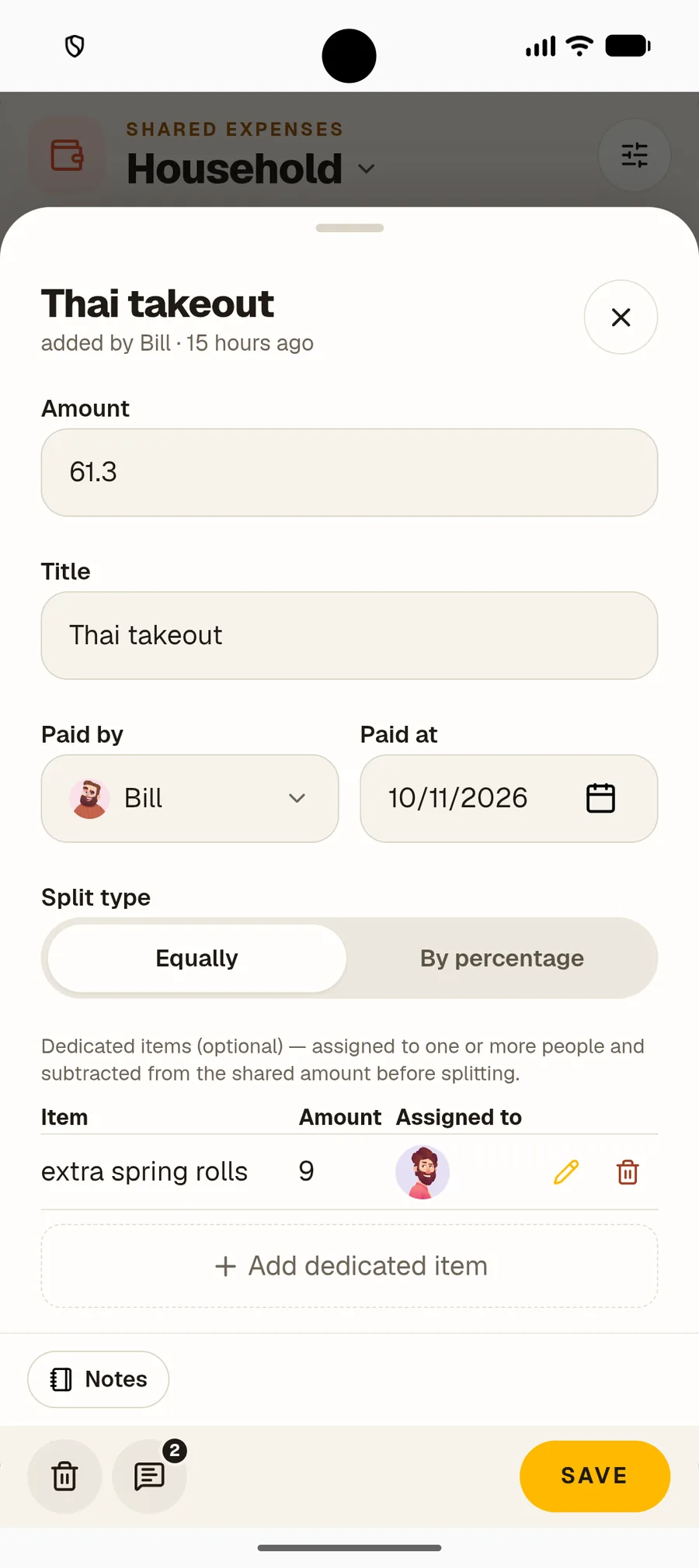
A calculator gives you the numbers once. Klusek keeps them going: set a 60/40 split on any expense, see a running balance of who owes whom, and settle up when you like.
- ✓Split any expense equally or by percentage
- ✓One running balance for the two of you
- ✓Comment on a bill instead of a tense chat
- ✓Shared grocery list, chores and notes in the same app
Free for yourself, no card needed. To share, only one of you needs Klusek Pass: $29.99 a year. Klusek for couples →

Common questions
Splitting bills by income: FAQ
How do you split bills by income?
+
Add both incomes together, then divide each partner’s income by that total to get their percentage. Each partner pays that percentage of every shared bill. If you earn 6,000 and your partner earns 4,000, you pay 60% and your partner pays 40%.
What is an income split?
+
An income split is a way to share bills in proportion to what each person earns. If you earn 60% of the household income, you pay 60% of the shared bills. It is also called a proportional split or a fair share split, and this calculator works it out for you.
What does a 60/40 split mean?
+
A 60/40 split means one partner pays 60% of the shared bills and the other pays 40%. It fits a couple where one person earns 60% of the combined household income. On 3,000 of monthly bills, that is 1,800 and 1,200.
Is it fair to split bills 50/50 when one partner earns more?
+
A 50/50 split is equal, but it is not always fair. When incomes differ, the lower earner hands over a much bigger share of their pay and has less left for savings and fun. Splitting bills by income means both partners give the same percentage of what they earn.
Should we use gross or net income to split bills?
+
Most couples use net income (take-home pay after tax), because that is the money you actually pay bills with. Gross income works too, as long as you both use the same one. Leave out money that is already committed, like child support you pay, if you both agree.
Which bills should we split by income?
+
Split the costs you share: rent or mortgage, utilities, groceries, internet, insurance, household supplies and shared subscriptions. Personal spending like your own clothes, hobbies or a gym membership usually stays with each person.
What if one partner has no income?
+
With a proportional split, a partner with no income pays 0% and the earning partner covers the shared bills. Many couples then agree on a small personal allowance for both, so each person still has money of their own.
How often should we recalculate our split?
+
Recalculate whenever an income changes: a raise, a new job, parental leave or going part time. Otherwise, a quick check once or twice a year keeps the split fair.
Does this calculator save my numbers?
+
No. The calculator runs in your browser and nothing is sent to us. Your numbers only live in the page address, so you can copy the link and send it to your partner.
Can I split bills by income in the Klusek app?
+
Yes. Klusek’s Shared Expenses lets you split any expense equally or by percentage, for example 60/40 by income. It keeps a running balance of who owes whom, so you can settle up whenever you like.