
Split expenses calculator
A trip expense splitter for any group: add who paid for what and get the fewest payments to settle up. Free, no sign-up.
How it works
How to split group expenses in 3 steps
Whether it is a trip, a hen party or a shared house, splitting costs between friends comes down to one number per person: what they paid minus what they used.
-

Step 1
Log who paid for what
Write down every shared cost, how much it was and who paid. Tick the people who took part in each one.
-
Step 2
Work out each balance
Add up what each person paid and their share of the costs. Paid minus share is their balance: plus is owed, minus owes.
-

Step 3
Settle with few payments
Match the person who owes the most with the one who is owed the most, and repeat. Three or four payments usually clear a whole trip.
The who owes who formula
Balance = what you paid − your share of every cost you took part in
All balances in a group always add up to zero. Whatever one person is owed, someone else owes, so the only question left is who pays whom.

Worked example
Splitting a weekend trip for four
John, Kate, Ania and Bill rent a cabin by the lake. Five receipts later, they spent 1,122.40 together, but not everyone joined everything.
Ania came by train, so the fuel for Bill’s car is split between John, Kate and Bill. Bill stayed on the shore during the boat trip, so the boat rental is split between the other three. Everything else is split four ways.
That is why the shares are not all 280.60: John and Kate used 295.10 each, Ania 267.10 and Bill 265.10. John paid for the cabin and the boat, so he is owed the most.
The trip’s expenses
| Expense | Paid by | Amount | Each pays |
|---|---|---|---|
| cabin booking (2 nights) split 4 ways |
John | 480 | 120 |
| groceries for the weekend split 4 ways |
Kate | 156.40 | 39.10 |
| fuel (bill’s car) split John, Kate, Bill |
Bill | 84 | 28 |
| dinner at luigis split 4 ways |
Ania | 312 | 78 |
| boat rental split John, Kate, Ania |
John | 90 | 30 |
| Total | 1,122.40 |

Settle up
How we find the fewest payments
If everyone paid back each person who covered them, the trip above would need 11 transfers. Netting the balances first and matching the biggest amounts brings it down to 3.
Step 1: net balances
| Person | Paid | Share | Balance |
|---|---|---|---|
| John | 570 | 295.10 | +274.90 |
| Kate | 156.40 | 295.10 | −138.70 |
| Ania | 312 | 267.10 | +44.90 |
| Bill | 84 | 265.10 | −181.10 |
| Total | 1,122.40 | 1,122.40 | 0 |
Step 2: match the biggest amounts
-
1
Bill pays John 181.10. John is owed the most (274.90) and Bill owes the most (181.10). Paying 181.10 settles Bill.
-
2
Kate pays John 93.80. John is owed the most (93.80) and Kate owes the most (138.70). Paying 93.80 settles John.
-
3
Kate pays Ania 44.90. Ania is owed the most (44.90) and Kate owes the most (44.90). Paying 44.90 settles both of them.
Every balance is now zero. 3 payments instead of 11.
Is it really the minimum?
Each payment settles at least one person completely, so a group of n people never needs more than n − 1 payments. This greedy “largest owes largest” match is what most settle-up apps use, and in practice it gives the fewest payments. In rare cases a smaller group inside the group cancels out on its own (Kate owes exactly what Ania is owed, say) and a hand-picked plan saves one payment, but finding that perfect plan for big groups is slow and almost never worth it.
Quick reference
How many payments a group needs
When everyone pays for something and everyone pays everyone back, the number of transfers grows fast. Settling net balances keeps it to one fewer than the number of people at most.
| Group size | Everyone pays everyone back | After netting, at most |
|---|---|---|
| 2 people | 2 payments | 1 payment |
| 3 people | 6 payments | 2 payments |
| 4 people | 12 payments | 3 payments |
| 5 people | 20 payments | 4 payments |
| 6 people | 30 payments | 5 payments |
| 8 people | 56 payments | 7 payments |
| 10 people | 90 payments | 9 payments |
| 12 people | 132 payments | 11 payments |
Fair, not just equal
Tips for splitting trip costs
Splitting everything evenly is quick, but it rarely feels fair after a long weekend. These are the questions that come up in almost every group.
-
Deposits paid months ago
Add the deposit as its own expense, paid by whoever booked. It is easy to forget once the rest of the bill is paid on arrival.
-
Someone joined late or left early
Split the stay per night. Add each night as a separate cost and untick the people who were not there that night.
-
Not everyone drinks
Ask for drinks on a separate bill, or log them as their own expense split only between the people who had them.
-
Couples who share money
Add a couple as one person, like “kate & john”, if they always pay together. It keeps the list short and the payments fewer.
-
Paid in two currencies
Convert everything to one currency before you split, using the rate from the day or your bank statement.
-
Settle while it is fresh
Share the result the day you get home. Small debts that sit for weeks are the ones that turn awkward.
Alternatives
Spreadsheet vs calculator vs app
Three common ways to track group expenses, and when each one fits.
| What you need | Spreadsheet | This calculator | Klusek app |
|---|---|---|---|
| Free to use | Yes | Yes | Free for yourself |
| No sign-up | Yes | Yes | No |
| Split between some people | By hand | Yes | Yes |
| Fewest payments to settle | By hand | Yes | Yes |
| Everyone adds their own costs | Shared file | One person | With Klusek Pass |
| Running balance over months | By hand | No | Yes |
| Comments on an expense | No | No | Yes |
| Multiple currencies | By hand | No | Yes |
One trip or one night out? This calculator is enough. Sharing a flat or travelling with the same friends often? A shared app saves you from rebuilding the list each time. For two people on different incomes, try the split bills by income calculator.

Shared Expenses in Klusek
Settle up without the maths
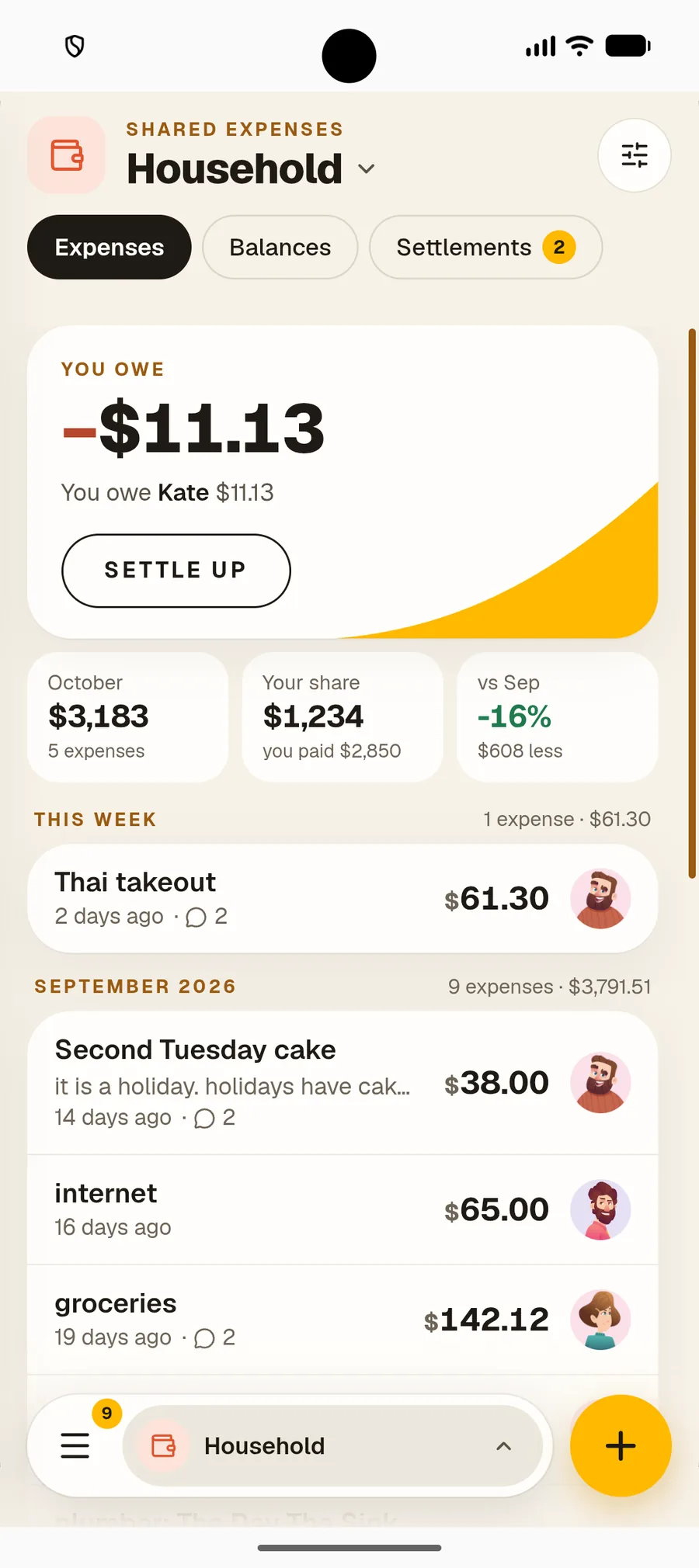
This calculator is a snapshot. In Klusek the whole group adds costs as they happen, the balance updates on its own, and the app shows the smallest set of payments that clears everyone’s balance.
- ✓A running balance of who owes whom
- ✓Settle up in a few payments, then start fresh
- ✓Split equally or by percentage, between anyone
- ✓Comment on an expense instead of the group chat
- ✓Expenses in more than one currency
Free for yourself, no card needed. To share, only one of you needs Klusek Pass: $29.99 a year. Klusek for roommates →


Common questions
Splitting group expenses: FAQ
How do you calculate who owes who?
+
Add up what each person paid, then work out each person’s share of every expense they took part in. Paid minus share is their balance: a positive balance means the group owes them, a negative one means they owe the group. Finally, people who owe pay the people who are owed until every balance is zero.
What is the fairest way to split trip costs?
+
Split each cost only between the people who used it. Shared basics like the cabin and groceries go to everyone, while a boat trip or drinks go to the people who joined in. Then net everything into one balance per person, so nobody pays for something they skipped.
How do I split if someone didn’t join every day?
+
Log costs per day or per activity and untick the person on the days they were not there. If the accommodation is booked as one price, split it per night: a 3-night cabin is three shares per person, so someone who stayed one night pays one share out of the total.
How does the calculator keep the number of payments low?
+
It matches the person who is owed the most with the person who owes the most, settles the smaller of the two amounts, and repeats. Each payment clears at least one person, so a group of n people never needs more than n − 1 payments, and in practice this gives the fewest payments.
Can I split an expense between only some people?
+
Yes. Every expense has its own “split between” checkboxes. Untick anyone who did not take part, for example the person who skipped the boat trip or did not drink. The cost is then shared only between the ticked people.
What happens to the extra cents when an amount does not divide evenly?
+
The calculator works in whole cents. When 100 is split three ways, two people get 33.33 and one gets 33.34, so the shares always add up to the exact amount and all balances add up to zero.
Does it work with any currency?
+
Yes, as long as every expense is in the same currency. If you paid in two currencies on a trip, convert them to one first. The Klusek app can track expenses in more than one currency for you.
Does this calculator save my expenses?
+
No. Everything runs in your browser and nothing is sent to us. Your group lives only in the page address, so you can copy the link and send it to the group chat.
How much do I owe my friend?
+
Add every cost you shared and who paid it, then tick who took part in each one. The calculator splits the costs and shows one line per payment, like “Bill pays Kate 42.50”. With just the two of you, that one line is how much you owe your friend, or they owe you.
Can I use this as a trip expense splitter?
+
Yes, that is what it is built for. Add the cabin, the petrol, the groceries and the dinners as you go, untick anyone who skipped a cost, and share the link at the end of the trip so everyone sees the same result.
Is there an app that tracks who owes who?
+
Yes. Klusek’s Shared Expenses keeps a running balance for your group as you add costs, shows who owes whom, and lets you settle up with the smallest set of payments. Everyone can add expenses and comment on them.