
Utility split calculator
Split energy, water and internet fairly, adjusted for working from home.
How it works
How to split utilities fairly
How to split utilities with roommates in three steps: keep fixed costs equal, and let the part of the energy bill that only exists because someone is home all day follow the people who are home.
-

Step 1
Sort the bills
Mark internet, streaming and other fixed prices as flat: they are split equally. Electricity, heating or gas and water are usage-based.
-

Step 2
Set the daytime share
Agree how much of each usage bill is daytime use, for example 25%. Only that part depends on who works from home.
-

Step 3
Split each part
The daytime part is split by work-from-home days, the rest by days at home. Add each person’s parts together for their total.
The utility split formula
Your share of a usage bill = bill × (1 − daytime share) × your days at home ÷ everyone’s days at home + bill × daytime share × your WFH days ÷ everyone’s WFH days
WFH days = work-from-home days per week ÷ 7 × days at home. A flat bill is simply bill ÷ number of people. If nobody works from home, the daytime part is split like the rest. Each bill is rounded to the cent so the shares add up to the bill exactly.

Worked example
Three roommates, one remote worker
John, Kate and Ania share a flat. Kate works from home 4 days a week, John 1 day, and Ania goes to the office every day. This month’s bills: electricity 150, heating 120, water 60 and internet 50, so 380 in total.
Internet is flat: 50 ÷ 3 = 16.67 each. The three usage bills add up to 330. With a 25% daytime share, 82.50 is daytime use and 247.50 is base use. The base part is 82.50 each. The daytime part follows the household’s 5 work-from-home days a week: Kate gets 4/5 of it (66) and John 1/5 (16.50).
An equal split would be 126.67 each. Instead, Kate pays 165.17, John 115.67 and Ania 99.16. Kate pays 38.50 more than an equal split because Kate works from home 4 days a week.
John, Kate and Ania’s utilities
| Bill | Total | John | Kate | Ania |
|---|---|---|---|---|
| Electricity | 150 | 45 | 67.50 | 37.50 |
| Heating / gas | 120 | 36 | 54 | 30 |
| Water | 60 | 18 | 27 | 15 |
| Internet | 50 | 16.67 | 16.67 | 16.66 |
| Total | 380 | 115.67 | 165.17 | 99.16 |
| Equal split | 126.67 | 126.67 | 126.66 |

Quick reference
Extra cost of a work-from-home day
What one person who works from home 5 days a week pays on top of an equal split, with a 25% daytime share. Find your monthly electricity, heating and water total on the left and your household size along the top.
| Usage bills a month | 2 people | 3 people | 4 people |
|---|---|---|---|
| 150 | +18.75 (0.87 a day) | +25.00 (1.17 a day) | +28.13 (1.31 a day) |
| 250 | +31.25 (1.46 a day) | +41.67 (1.94 a day) | +46.88 (2.19 a day) |
| 400 | +50.00 (2.33 a day) | +66.67 (3.11 a day) | +75.00 (3.50 a day) |
| 600 | +75.00 (3.50 a day) | +100.00 (4.67 a day) | +112.50 (5.25 a day) |
The rule behind the chart: extra a month = usage bills × daytime share × (1 − 1 ÷ number of people). A higher daytime share in winter raises it, a shared home with more remote workers lowers it, because the daytime part is then split between them.
Fair vs equal
Is it fair to charge more for working from home?
Often, yes, but only a little. A roommate who is home all day does use more heating, light and hot drinks. Asking them to cover all of it can feel petty, and splitting everything equally can feel unfair to the people who are out. A small, agreed adjustment usually keeps the peace.
Why a WFH adjustment works
- ✓Office-goers don’t pay for heating they never feel
- ✓The remote worker pays for real use, not a guess
- ✓It adjusts with the seasons through the daytime share
- ✓Fixed costs like internet stay simple and equal
Where it gets tricky
- ?Others heat the home in the evening and at weekends too
- ?A long shower or a gaming PC can outweigh a laptop
- ?Some employers already pay a home-working allowance
- ?Tracking every kettle boil costs more goodwill than it saves
Alternatives
Other ways to split utilities
The work-from-home split is one option. These are the other methods roommates use, and when each one fits.
-
Equal split
Add up the bills and divide by the number of people. Quick and hard to argue with.
Best when everyone keeps similar hours.
-

By room size
Split heating by the share of floor space each person’s room takes up, like rent.
Best when rooms differ a lot in size.
-

Sub-metering
A plug-in meter or a separate heater meter shows exactly what one room uses.
Best for a space heater or a home office.
-

A flat extra
The remote worker adds a fixed amount each month, for example 20, and the rest is split equally.
Best when you want zero maths.
Splitting the rent too? Try the rent split calculator, or see how Klusek for roommates keeps every shared cost in one place.
Save together
Tips to cut shared utility bills
The fairest split is a smaller bill. These habits help most in a shared home, especially when someone is home all day.
-
1
Heat one room, not the whole home
When only the remote worker is in, keep the heating low and warm the home office. A door kept closed does a lot.
-
2
Agree on a thermostat range
Pick a daytime and an evening temperature together. Fewer quiet adjustments, fewer arguments.
-
3
Switch off at the wall
Monitors, consoles and chargers on standby add up across four people. A switched power strip at each desk helps.
-
4
Boil only what you need
Kettles and ovens are some of the biggest daytime users. Fill the kettle for one cup and batch-cook.
-
5
Run full loads, off-peak
Wait for a full washing machine or dishwasher and run it when your tariff is cheapest.
-
6
Check the tariff once a year
Compare energy and internet plans before the contract renews. One person checks, everyone saves.

Shared Expenses in Klusek
Utilities, settled every month
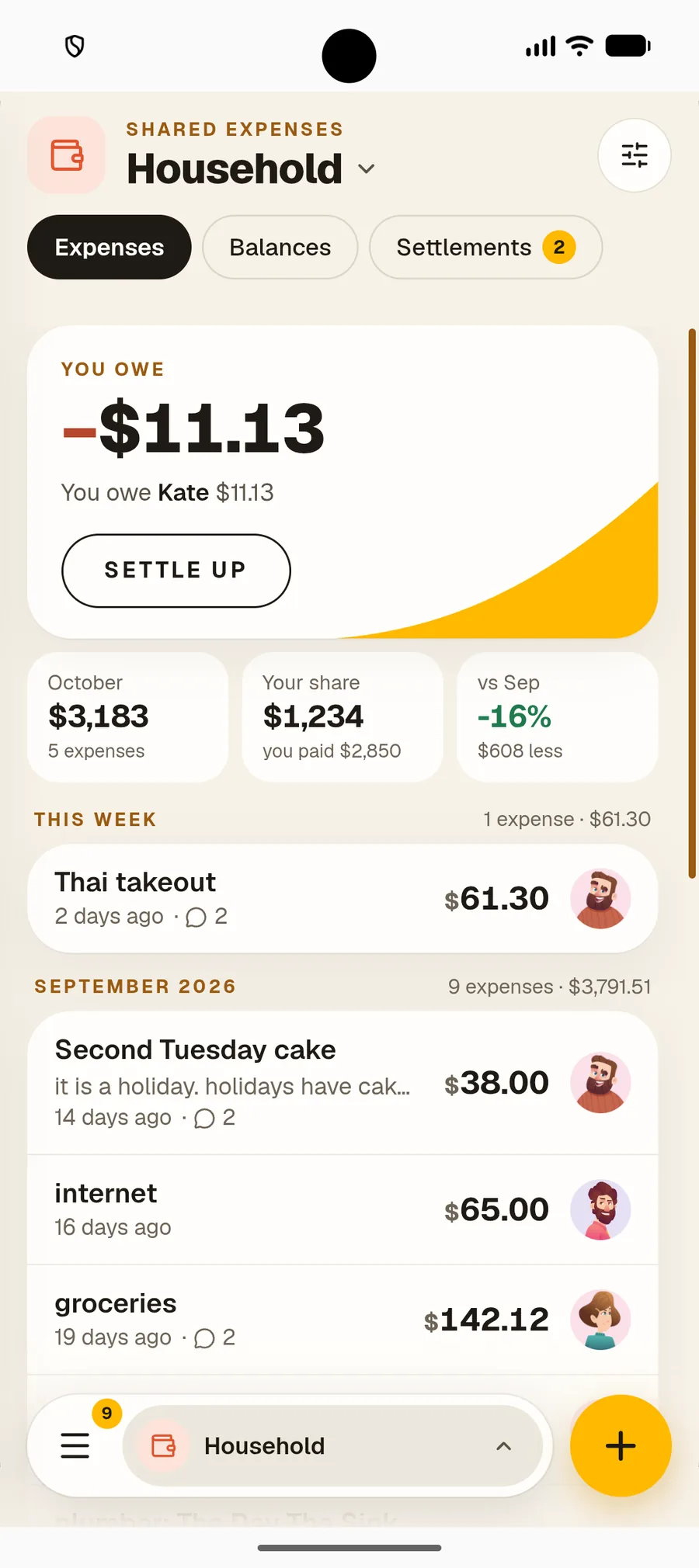
A calculator splits one month. Klusek keeps the whole flat on track: add the energy bill when it arrives, split it equally or by percentage, and see one running balance of who owes whom.
- ✓Split any bill equally or by percentage
- ✓One running balance for the whole flat
- ✓Comment on a bill instead of a group-chat debate
- ✓Shared shopping list, chores and notes in the same app
Free for yourself, no card needed. To share, only one of you needs Klusek Pass: $29.99 a year. Klusek for roommates →

Common questions
Splitting utilities: FAQ
How do you split utilities with roommates?
+
The simplest way is to add up the month’s utility bills and divide by the number of people. It gets fairer if you split flat bills like internet equally, and split usage-based bills like electricity and heating partly by who is home during the day. This calculator does both and shows each person’s share.
What is a fair way to split utilities when one person works from home?
+
Treat part of the energy bills as daytime use and split that part by work-from-home days. The rest is split equally. With a 25% daytime share, a roommate who works from home 4 days a week pays a bit more for electricity and heating, but internet and the base usage stay equal.
How does the work-from-home adjustment work?
+
For each usage-based bill: bill × daytime share is split in proportion to each person’s work-from-home days in the period, and bill × (1 − daytime share) is split by days at home. Work-from-home days = days per week ÷ 7 × days at home. Flat bills are split equally. Amounts are rounded to the cent so they add up to the bill exactly.
What daytime share should we use?
+
Use 15–20% in mild months, when a remote worker mostly adds laptop power, lights and the kettle. Use 30–40% in winter or summer, when the heating or air conditioning runs all day only because someone is home. 25% is a sensible middle. Pick a number you all agree on and keep it for a few months.
How much does working from home add to the electricity bill?
+
A laptop, a monitor and lights add very little. The big costs are heating, cooling and cooking at home during the day. That is why the calculator adjusts electricity, heating and water, but keeps internet flat: the connection costs the same whoever uses it.
How do we split utilities when a roommate is away?
+
Enter the days they were away. Their share of usage-based bills drops in proportion to the days they were home, because the base part is split by days at home. Flat bills like internet stay equal, since the cost does not change while someone travels.
Should internet be split by usage?
+
Usually not. Internet is a fixed monthly price, so most households split it equally. If one person needs a faster plan only for work, they can pay the difference between the basic plan and the faster one.
Does this calculator save our numbers?
+
No. Everything is calculated in your browser and nothing is sent to us. Your numbers live only in the page address, so you can copy the link and send it to your roommates.
Can we track shared utility bills in Klusek?
+
Yes. Klusek’s Shared Expenses lets you add each bill, split it equally or by percentage, and keeps a running balance of who owes whom, so roommates can settle up once a month.