
Who does more housework? Take the quiz
Pick who does each of 18 chores and see your real split, weighed by time.
How it works
How the chore split score works
Counting chores is misleading: the bins take minutes, dinner takes hours. So the quiz weighs every chore by a rough weekly time and adds up each person’s share.
-

Step 1
Pick who does it
For each chore, choose me, mostly me, shared, mostly them or them. That is 100%, 75%, 50%, 25% or 0% of the chore for you.
-

Step 2
Weigh it by time
Each chore has a rough number of minutes per week. Cooking at 300 minutes counts far more than the bins at 20.
-

Step 3
Add up your shares
Your minutes divided by all the minutes is your share. Planning and remembering jobs also get their own mental load split.
The chore split formula
Your share = sum of (your part × minutes per week) ÷ sum of all minutes
Chores marked “Nobody” or “N/A” are left out. “Chores that tip the balance” are the ones where one-sidedness times time is biggest, so they are the best place to start rebalancing.
Why it matters
Why the chore split matters
Housework is one of the most common things couples and roommates argue about. Rarely because of one dirty pan, usually because one person quietly feels they carry more.
What the research keeps finding
- ✓Housework is often split unevenly in couples, even when both partners work full time.
- ✓People tend to overestimate their own share, because they see every job they do and only some of the other person’s.
- ✓Feeling that the split is unfair tends to matter more for a relationship than the exact hours.
- ✓The planning and remembering side of a home is the easiest part to overlook.
Why take the quiz together
A number on a screen is easier to talk about than “you never do anything”. When you both answer, you see where your views match and where they don’t, and the conversation starts from the chores, not from blame.
It works the same for roommates: a shared flat runs smoother when everyone can see who does what, instead of guessing.

Example result
John and Kate’s 44/56 split
John takes the quiz. He does the dishes, the vacuuming and the bins, and shares tidying and the weekly shop. Kate does most of the cooking and laundry, and nearly all the planning.
By count, they each look busy. By time, John does about 8.5 h a week and Kate about 11 h, a 44 /56 split. The mental load leans further: 20/80. Nobody does the repairs, so the dripping tap keeps dripping.
Cooking alone tips the balance most. If John cooked two weeknight dinners, they would be close to even. Sharing the meal planning would ease the mental load too. That is the kind of small swap the quiz is meant to point at.
Who does what at John and Kate’s
| Chore | Who | Min/wk |
|---|---|---|
| Cooking meals | Mostly Kate | 300 |
| Dishes and kitchen clean-up | Mostly John | 180 |
| Tidying up | Shared | 120 |
| Laundry | Mostly Kate | 120 |
| Vacuuming and mopping | John | 60 |
| Cleaning the bathroom | Mostly Kate | 45 |
| Grocery shopping | Shared | 90 |
| Bins and recycling | John | 20 |
| Changing the bedding | Shared | 20 |
| Planning meals | Kate | 45 |
| Noticing when things run out | Mostly Kate | 20 |
| Booking appointments | Kate | 20 |
| Birthdays and gifts | Kate | 30 |
| Keeping track of bills | Mostly John | 30 |
| Running the shared calendar | Mostly Kate | 20 |
| Repairs and DIY | Nobody | 30 |
| Plants and garden | Mostly John | 30 |
| Split by time | John 44% · Kate 56% | |
Quick reference
How long do chores take each week?
These are the rough weekly times the quiz starts with, for a two-person home. They are estimates, not measurements: a family of five or a flat with a dog will look different.
| Chore | Type | Minutes a week | Hours a month |
|---|---|---|---|
| Cooking meals | Visible | 300 | 21.7 |
| Dishes and kitchen clean-up | Visible | 180 | 13 |
| Tidying up | Visible | 120 | 8.7 |
| Laundry | Visible | 120 | 8.7 |
| Grocery shopping | Visible | 90 | 6.5 |
| Pet care | Visible | 90 | 6.5 |
| Vacuuming and mopping | Visible | 60 | 4.3 |
| Cleaning the bathroom | Visible | 45 | 3.3 |
| Planning meals | Mental load | 45 | 3.3 |
| Birthdays and gifts | Mental load | 30 | 2.2 |
| Keeping track of bills | Mental load | 30 | 2.2 |
| Repairs and DIY | Visible | 30 | 2.2 |
| Plants and garden | Visible | 30 | 2.2 |
| Bins and recycling | Visible | 20 | 1.4 |
| Changing the bedding | Visible | 20 | 1.4 |
| Noticing when things run out | Mental load | 20 | 1.4 |
| Booking appointments | Mental load | 20 | 1.4 |
| Running the shared calendar | Mental load | 20 | 1.4 |
| All chores | 1,270 | 91.7 |
Daily jobs add up fastest: cooking and dishes alone are more than a third of the weekly total. That is why one person owning dinner can tip the whole split.
The invisible part
What counts as mental load?
The mental load is the thinking behind the chores: noticing, planning, remembering and deciding. It barely shows up on a clock, but it is never really off.
“Just tell me what to do” sounds helpful, yet it leaves the planning with one person. Taking a chore fully means taking the noticing too: knowing when the bin day is, not just carrying the bag out when asked.
- ✓Planning. What is for dinner this week, what to buy, when to clean.
- ✓Noticing. The soap is low, the plants look dry, the towels need a wash.
- ✓Remembering. Birthdays, bin day, when the car is due, who needs a gift.
- ✓Booking. Doctor, dentist, vet, a plumber, a babysitter.
- ✓Keeping track. Bills and due dates, paperwork, who paid for what.
- ✓Delegating. Asking, reminding and checking that something got done.
Fair, not just equal
How to split chores fairly
A fair chore split is one you both chose. It does not have to be 50/50: if one of you works longer hours, 60/40 can feel right. These are the methods couples and roommates use most.
-

By preference
Each of you picks the chores you mind least. One person likes cooking, the other would rather clean up.
Best when your tastes differ.
-
Rotating
Swap chores every week or month, so everyone does the good and the bad ones in turn.
Best for roommates and shared flats.
-

By time
Add up the weekly minutes, like in the quiz, and split them evenly or in line with your working hours.
Best when hours outside home differ.
-

By what you hate least
Rank the worst jobs, then trade: you take the bathroom, I take the bins and the laundry.
Best for the chores nobody wants.
Tips that make any split stick
- ✓Give every chore one owner, not “whoever notices”
- ✓Hand over whole jobs, including the planning part
- ✓Start with the chores that tip the balance most
- ✓Agree what “done” means, then let it be done their way
- ✓Write it down where you both can see it
- ✓Check in every few weeks and adjust without blame
Sharing a flat? Take the quiz with each roommate, then put the chores on one shared list. Klusek for roommates keeps the list, the bills and the house notes in one place.

To-do Lists in Klusek
Chores, shared
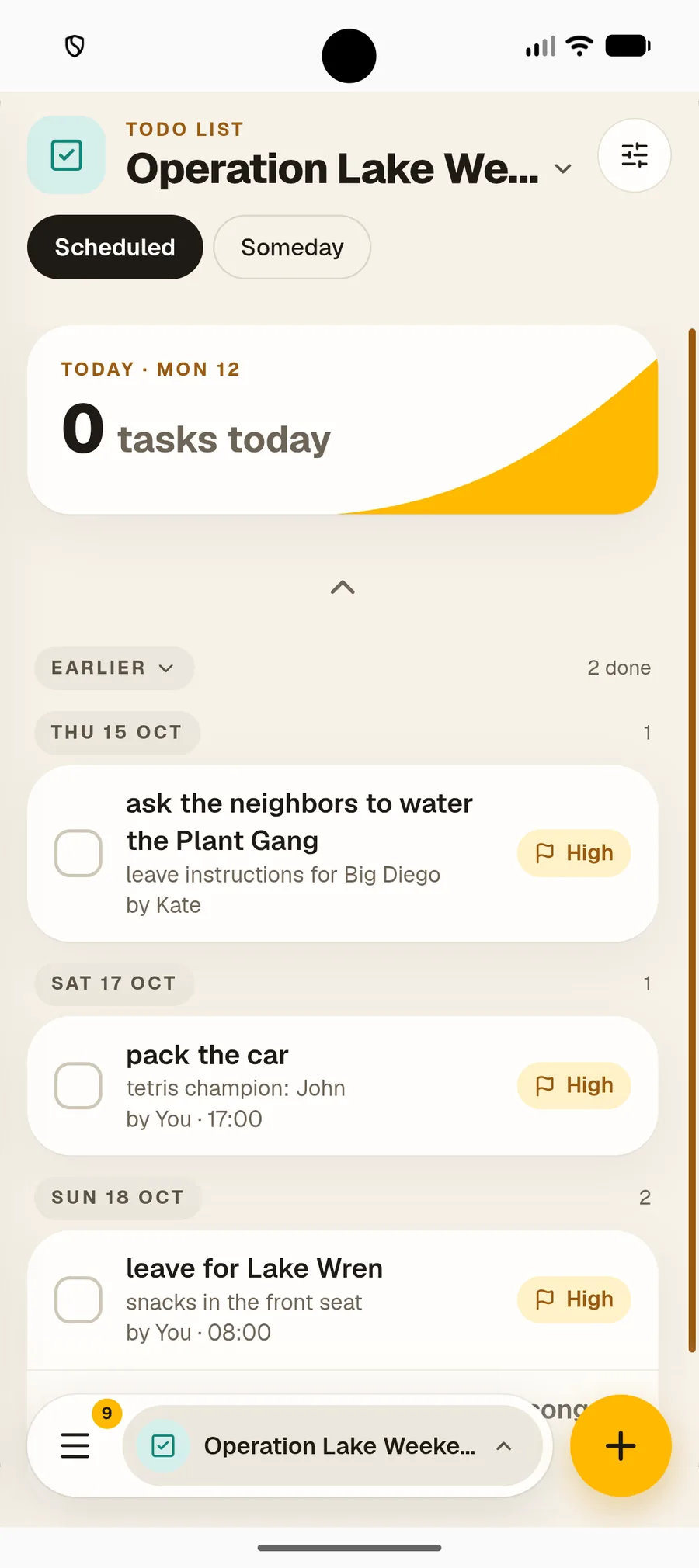
The quiz shows you the split once. Klusek keeps it fair: one shared chore list with an owner and a day for every job, on both your phones, so nobody has to hold it all in their head.
- ✓Assign each chore to a person
- ✓Plan it for a day and see what is done
- ✓Shared grocery list for the weekly shop
- ✓Split bills and notes in the same app
Free for yourself, no card needed. To share, only one of you needs Klusek Pass: $29.99 a year. Klusek for couples →

Common questions
Housework split: FAQ
How does the who does more housework quiz work?
+
You go through 18 common chores and pick who does each one: you, mostly you, shared, mostly them or them. Each chore has a rough number of minutes per week, so the quiz shows your housework split by time, not just by how many chores you each have. You also get a separate split for the mental load.
Why does the quiz weigh chores by time?
+
Taking out the bins and cooking dinner every night are not the same amount of work. Counting chores would treat them equally. Weighing each chore by its weekly minutes gives a more honest picture. You can change the minutes to match your home, or switch to counting chores instead.
What is the mental load in a relationship?
+
The mental load is the planning, noticing and remembering that keeps a home running: knowing what is for dinner, spotting that the soap is running out, booking the dentist, remembering birthdays. It takes little time on the clock but a lot of attention, and it is easy for the other person not to see it.
Can my partner take the quiz too?
+
Yes. Use “Send to your partner to answer too”. Your partner opens the link, answers from their side without seeing your answers, and then sees both views side by side. People often see their own share as bigger than their partner does, so comparing is the interesting part.
Does this work for roommates?
+
Yes. Put in your roommate’s name instead of a partner’s and mark chores that do not apply, like pet care, as N/A. The quiz compares two people at a time, so in a bigger house you can take it with each roommate.
What is a fair split of household chores?
+
Fair does not have to mean 50/50. If one person works much longer hours, a 60/40 split of housework can feel fair to both of you. What matters is that the split is something you chose together, not something that just happened, and that neither of you feels taken for granted.
How do we split chores more fairly?
+
Start with the chores that tip the balance in your result. Swap one or two of them, give each chore a clear owner rather than “whoever notices”, and hand over whole jobs including the planning part. Rotating the chores nobody likes and checking in every few weeks helps it stick.
Are my answers saved anywhere?
+
No. The quiz runs in your browser and nothing is sent to us. Your answers only live in the page address, so the link you share is the only copy.
Can I track chores in the Klusek app?
+
Yes. Klusek’s To-do Lists let you write a shared chore list, assign each task to a person, set a date and see what is done. Both of you see the same list on your phones, so nobody has to keep it all in their head.