
Cascadia score calculator
Wildlife cards, habitat corridors and nature tokens. The majority bonuses are worked out for you.
Start a game
Type who is playing and get a clean score sheet. Empty names become Player 1, Player 2 and so on.
Prefer pen and paper?
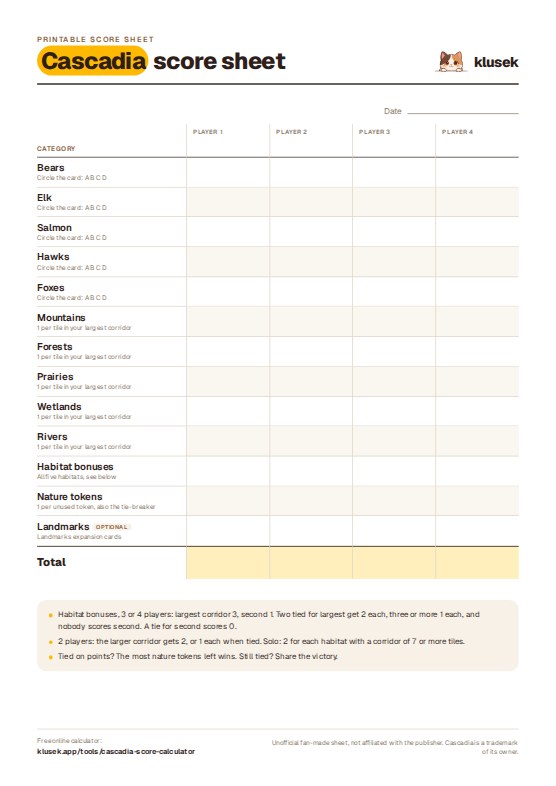
Printable Cascadia score sheet
Our free Cascadia score sheet follows the order of the score pad: a row for each of the five animals (circle the A, B, C or D card in play), the five habitat corridors, the habitat majority bonuses and nature tokens, with a spare row for Landmarks and columns for up to 4 players.
The majority bonus rules for every player count are printed at the bottom. Or use the calculator above, which works out the bonuses and the tie-breaker for you.
Free PDF, 1 page. Print as many copies as you need.
Cascadia scoring rules
How Cascadia scoring works
After exactly 20 turns each, the game ends and every player adds up four things from the environment they built. Here is each step, in the order of the score pad.
-
Step 1
Wildlife scoring cards
One card per animal is in play, and everyone scores with the same five. Count each animal against its card: bears, elk, salmon, hawks and foxes.
Example: With bear card A, two pairs of bears score 11 points.
-
Step 2
Habitat corridors
For each of the five habitats, score 1 point per tile in your largest connected group of that habitat. Tiles connect when a matching edge touches.
Example: A group of 3 forests and a group of 4 forests score 4, not 7.
-
Step 3
Habitat majorities
Compare everyone’s largest corridor in each habitat. The biggest ones earn bonus points, and the rule depends on the player count (see the table below).
Example: In a 3-player game, the largest wetland corridor earns 3 bonus points.
-
Step 4
Nature tokens
Each nature token you did not spend is worth 1 point. Nature tokens also break ties for the win.
Example: 2 unused nature tokens score 2 points.
The Cascadia scoring formula
Final score = wildlife + habitat corridors + majority bonuses + nature tokens
The highest total wins. If players tie, the one with the most nature tokens left wins. If they are still tied, they share the victory.
Wildlife scoring cards
Every wildlife card, A to D
Each game uses one of four cards per animal, which is why two games of Cascadia can score so differently. Here is what each card rewards. The exact points are printed on the card.
Bear
Bear groups can have any shape, but two groups may not touch, and each group must be the exact size the card shows.
| Card | What scores |
|---|---|
| A | Groups of exactly 2 bears. The more pairs you have (up to 4), the more points. |
| B | 10 points for each group of exactly 3 bears. |
| C | Groups of 1, 2 or 3 bears score by size, plus 3 bonus points if you have one group of each size. |
| D | Groups of 2, 3 or 4 bears score by size. Bigger groups are worth more. |
Elk
Elk groups may touch, but each elk scores once. Count connected elk in the way that gives the most points.
| Card | What scores |
|---|---|
| A | Straight lines of 1 to 4 elk, joined flat side to flat side. Longer lines score more. |
| B | Groups in the exact shapes on the card (1, a pair, a triangle of 3, a diamond of 4), in any orientation. |
| C | Any connected group of elk, in any shape. Points grow with the size of the group. |
| D | Elk in a circular formation, as pictured on the card. Points grow with the number of elk in the ring, up to 6. |
Salmon
A run is a chain of salmon where each touches no more than 2 others, with no other salmon next to it.
| Card | What scores |
|---|---|
| A | Each run of salmon scores by size, up to 7 salmon. |
| B | Each run of salmon scores by size, up to 5 salmon. |
| C | Only runs of 3, 4 or 5 salmon score. Shorter runs score nothing. |
| D | Each run scores 1 point per salmon plus 1 point per animal token next to it, of any kind. |
Hawk
A line of sight is a straight line across flat sides of the hexes. Another hawk blocks it.
| Card | What scores |
|---|---|
| A | Each hawk not next to another hawk. The more lone hawks, the more points. |
| B | Each hawk not next to another hawk that also has a straight line of sight to another hawk. |
| C | 3 points for each line of sight between two hawks. One hawk can be part of several lines. |
| D | Each pair of hawks scores by the number of different animal types between them (hawks do not count). Each hawk is in one pair only. |
Fox
Each fox, or fox pair on card D, scores on its own, counting only the animals right next to it.
| Card | What scores |
|---|---|
| A | Each fox scores by the number of different animal types next to it, other foxes included. |
| B | Each fox scores by the number of different animal pairs next to it. Fox pairs do not count. |
| C | Each fox scores by the number of animals of the most common type next to it. Other foxes do not count. |
| D | Each pair of foxes scores by the number of different animal pairs next to it. Other fox pairs do not count. |
First game? The rulebook suggests playing with all five A cards.
Habitat majority bonuses
Habitat bonus by player count
This is the part of Cascadia scoring people get wrong most often. After counting corridors, each habitat type is compared on its own.
| Players | Largest corridor | Second largest | Ties |
|---|---|---|---|
| 1 (solo) | 2 points if 7 tiles or more | none | no ties in solo |
| 2 | 2 points | none | tied for largest: 1 point each |
| 3 or 4 | 3 points | 1 point | two tied for largest: 2 each, no second place. Three or four tied: 1 each. Tied for second: 0 each |
The bonus goes to each habitat type separately, so one player can win the mountain bonus while another takes rivers. A habitat you have no tile of never earns a bonus.


What is a good score?
What is a good Cascadia score?
The rulebook rates solo games with a chart, and it is a handy yardstick for any game: 80 points is very good and 100 or more is elite.
Rulebook solo chart
| Score | Rating |
|---|---|
| 60+ | A good start! |
| 70+ | You’re getting it! |
| 80+ | Very good! |
| 90+ | Excellent! |
| 100+ | Elite! |
| 110+ | Ascended! |
Scores depend a lot on the cards in play: some combinations give everyone more points. Compare games played with the same five cards, and in multiplayer, look at the gap to the other players rather than the raw number.
Common scoring mistakes
- Adding every habitat tile. Only the largest connected group of each habitat counts.
- Giving the second place bonus after a tie for first in a 3 or 4 player game.
- Using the 3 to 4 player bonuses in a 2-player game (it is 2 points, or 1 each when tied).
- Forgetting the unused nature tokens, which are worth 1 point each.
- Counting an elk or a hawk in two groups or pairs.