
You paid for Mum and Dad's present on your card again this year and sent the siblings' group chat a cheerful "it's £60 each, no rush". Someone had the idea, someone else had the link, and somehow the bill landed with you. If you're working out how to split Christmas costs with siblings, the trick is to agree three things early: what you're paying for together, how you divide it, and who keeps track.
Brothers and sisters are usually generous with each other. It's the vague bits that cause the odd grumble, so let's make them less vague.
What siblings usually share at Christmas
Every family is different, but these are the usual shared costs:
- The parents' gift. One bigger present from all of you, often nicer than anything you'd each buy alone.
- Christmas dinner. Whether it's at your parents' house, at one sibling's place, or in a restaurant.
- Food and drink contributions when one of you hosts.
- Grandparents' or an aunt's gift, if you go in together.
- Travel, if you share a car or a train trip back home.
Write them on a list before anyone spends a penny. It takes two minutes and it saves a lot of "wait, did we agree on this?".
Splitting the parents' Christmas gift
This is the most common one. Three simple ways:
- Equal shares. Price ÷ number of siblings. The easiest by far, and the fairest when everyone's in a similar place.
- Per household. Married or living-together siblings count as one share. Useful when partners chip in too.
- What each person can manage. If one of you is a student or between jobs, the others quietly cover a bigger slice. This is very normal and very kind. Agree it privately, so nobody feels put on the spot.
Agree a budget before anyone shops. "Up to £150 together" is much easier than discovering the price tag after it's been bought.
The fairest split is the one everyone agreed on before the shopping started.
Christmas costs per household or per person?
When you're splitting the dinner, this is the big question. Imagine three siblings: one single, one in a couple, one with a partner and two children.
- Per person: fair on paper, but the family of four pays twice what the couple pays, which can feel like a lot with small children who eat three potatoes.
- Per household: everyone pays the same. Simple, and often kinder to the bigger family.
- Per adult: a nice middle way. Children eat free, every grown-up pays one share.
Per adult is a lovely default for lots of families. It's easy to explain and nobody ends up paying for a toddler's half-eaten pudding.
If one of you is hosting, our guide to who pays for Christmas dinner has more fair options, and some kind ways to bring the money up.
How to split Christmas costs with siblings: who keeps track
Usually one sibling ends up as the family treasurer, without anyone voting. It's a kind job, so make it easy for them:
- Whoever pays, logs it straight away, with the amount and what it was for.
- Use one shared place, not three group chats and a photo of a receipt.
- Settle up once, in January, when everyone's been paid.
For a one-off, our free split expenses calculator does the maths: add who paid for what, untick anyone who wasn't part of a cost, and it shows the fewest payments that settle everyone up. No sign-up, any currency.
A few things that keep it friendly
- Say the numbers out loud. "Is £50 each OK?" is a perfectly nice message.
- Let someone opt out of the big gift without a fuss, and let them give something small of their own instead.
- Keep Secret Santa separate. If your siblings do a gift swap with partners and kids, our Secret Santa questionnaire helps everyone buy something they'll love.
- Remember the partners. If you're also juggling two families, our guide to Christmas with two families covers the time and the travel.
How Klusek helps us share family costs
In our family, shared costs like this go into a list in Klusek's Shared Expenses. Whoever pays for something adds it, and the list keeps one running balance, so at the top you see exactly where you stand ("you owe Kate…", or happily the reverse). When it's time to settle, Klusek shows the smallest set of payments that clears everyone, and you mark it settled.
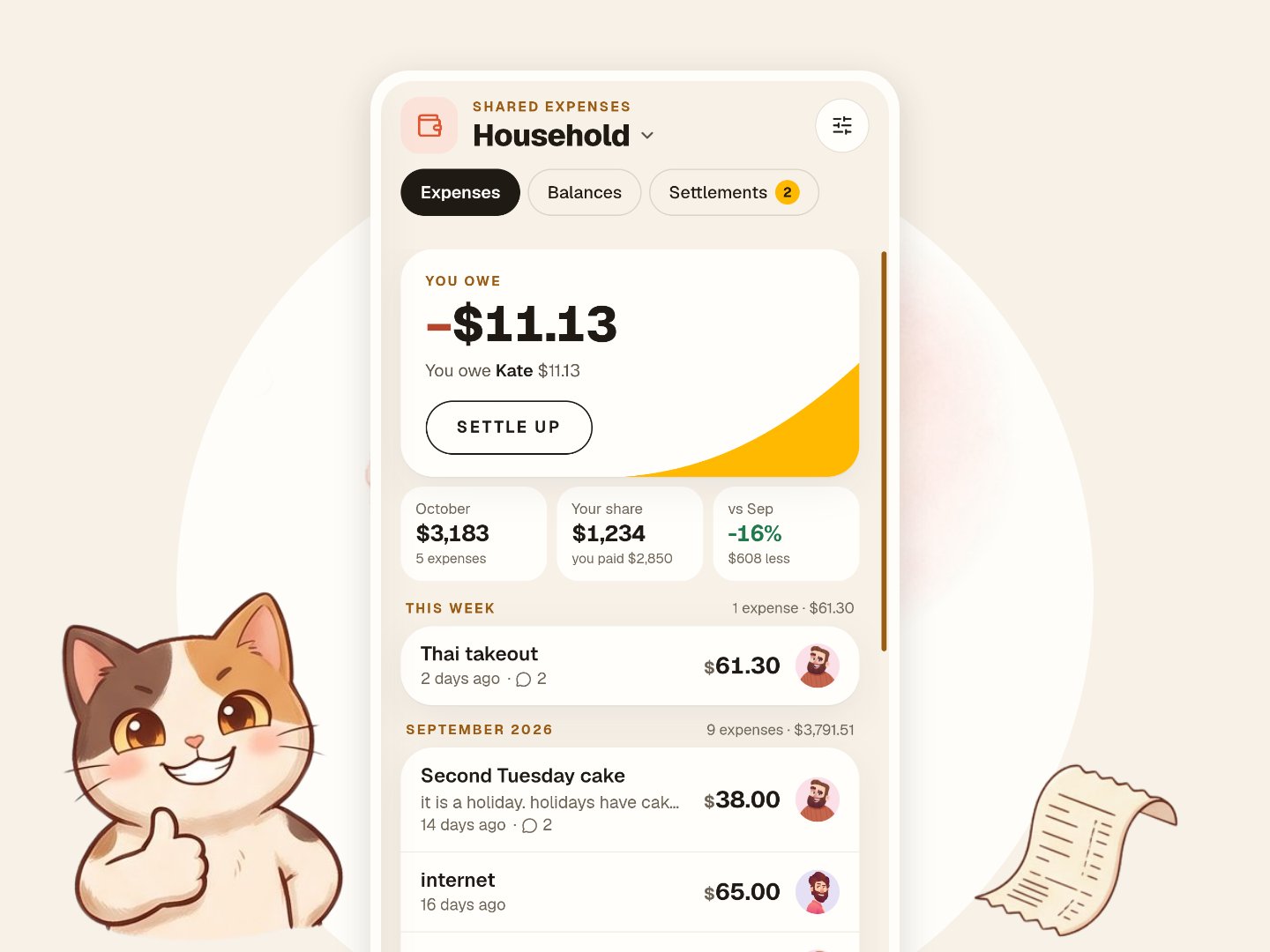
Each expense can be split equally or by percentage, so a "50/30/20" deal for the parents' gift is one tap. You can add expenses in different currencies too, which helps if one of you lives abroad. Klusek is free when you use it on your own. To share the list with your siblings, one of you needs a Klusek Pass, and the people you invite join for free.
The nice part
Splitting Christmas costs with siblings is really about doing something together: a better gift than any of you would buy alone, a dinner where nobody is quietly out of pocket. So send the message tonight. Suggest a budget, a way to split it, and who keeps track. Your siblings will probably be relieved someone asked.