
Yoghurt, an apple and half a lemon on one shelf of the fridge; chicken, cheese and the big tub of protein something on all the others. If you're working out how to split groceries as a couple when one of you eats noticeably more, there's no single right answer. There are four good ones, and the best is the one that feels fair to both of you and doesn't need a calculator every Saturday.
And just to say it early: eating more isn't a crime. Someone who goes to the gym five times a week, or simply has a bigger appetite, is not doing anything wrong. This is about finding a split that feels nice, not about counting biscuits.
How do couples split grocery bills? Four ways that work
1. Straight 50/50
You add up the shop and halve it. It's simple and it feels like a team. It works best when you eat roughly the same, or when the difference is small enough that neither of you minds.
Watch out for: a quiet "hmm" every time the receipt has three steaks on it. If one of you starts feeling it, that's the sign to try something else.
2. Split by income
If one of you earns more, you can split the food shop in the same proportion as your incomes. Earn 60% of the household money, pay 60% of the shop. Our free split bills by income calculator does the maths for you, and our post on whether couples should split bills 50/50 explains when this feels fairer.
3. Shared basics, own extras
This is the one many couples end up with. Everything you both eat (bread, milk, veg, pasta, washing-up liquid, the Sunday roast) goes in the shared pot and is split. Anything only one of you eats or drinks, like protein bars, the special coffee pods or your fancy cheese, you pay for yourself.
It's fair, it's easy to explain, and it respects that you're two people with two sets of tastes. A friendly house rule helps: if it's in the fridge without a name on it, it's shared.
4. Take turns or use a joint pot
Some couples alternate who does the weekly shop, or both pay a set amount into a joint account each month and the food comes out of that. It's lovely when your shops cost roughly the same each week and you'd rather not track anything.
The fairest split isn't the most precise one. It's the one neither of you thinks about on the way home from the shop.
A worked example (in pounds and dollars)
Let's say your monthly food shop comes to £600 (or $600, the maths is the same). Of that, about £90 is things only one of you has: £70 of protein snacks and steak for Sam, £20 of oat milk and special tea for Alex.
- 50/50 on everything: Sam pays £300, Alex pays £300.
- By income (Sam earns 60%): Sam pays £360, Alex pays £240.
- Shared basics 50/50, own extras: Sam pays £325, Alex pays £275.
How the last one works: £600 minus £90 of personal items leaves £510 of shared food. Half each is £255. Sam adds £70, Alex adds £20.
None of these is wrong. Look at the numbers together and pick the one you both nod at.
How to split groceries as a couple without it getting awkward
A few small things make this much easier:
- Talk about it once, properly, then stop. Choose a method, try it for a month, then check in. No re-negotiating at the checkout.
- Make it a bit funny. "Fine, the cheese gets its own budget line" is a much nicer conversation than a tally.
- Keep one list. If you both add to the same shared shopping list, there's less "I didn't know we needed that".
- Settle up regularly. Once a month is plenty. Small amounts that pile up for half a year turn into a big, strange number.
- Allow for life changing. A new job, a training plan or a pregnancy can change who eats what. It's fine to change the split too.
If you're also sharing rent and bills, our guide on how to split bills with roommates has ideas that work just as well for couples.
How Klusek helps us with this
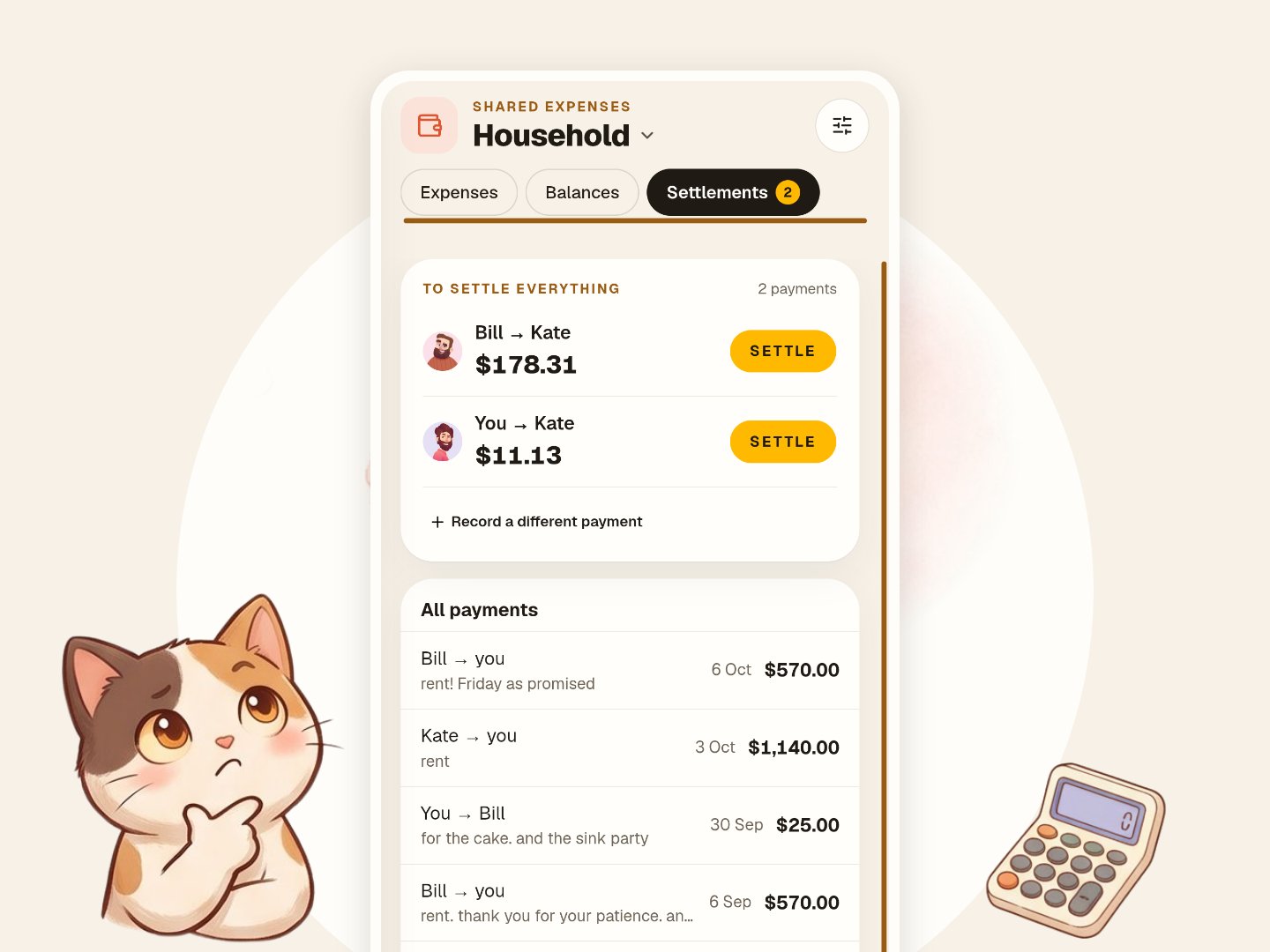
In our home, the shop goes from the list straight into Klusek's Shared Expenses. Whoever paid adds the receipt, picks equal or by percentage (60/40 by income takes one tap), and the running balance updates for both of us.
At the end of the month, the Settlements tab shows exactly who should pay whom and how much, as the fewest payments possible. You tap Settle, it goes into the history, and you start fresh. If a bill needs a word, you can leave a comment right on it, like "the steak was a birthday treat, I'll cover it".
Klusek is free when you use it on your own. To share expenses with your partner, one of you needs a Klusek Pass, and your partner joins for free. More on that on our Klusek for couples page.
Whatever you choose
The fact that you're reading this means you care about it feeling fair, and honestly, that's most of the work done. Have a cup of tea, pick a method, and try it for a month.
And if you're the one with the big appetite: maybe buy the next block of cheese yourself. It goes a long way.