

Should couples split bills 50/50? It works well when you earn about the same. When your incomes are quite different, a split by income, or a shared pot, often feels fairer to both of you. Exactly half looks perfectly tidy on paper, right up until one of you has a lot left over at the end of the month and the other is quietly counting the days to payday.
There's no single right answer here, and anyone who tells you there is probably hasn't lived with your particular boiler. What helps is seeing the options side by side, with real numbers, and then picking the one that makes both of you relax a little when the bills arrive.
Should couples split bills 50/50? When it works, and when it wobbles
Half and half is simple. Nobody needs a spreadsheet, nobody feels like a guest in their own home, and it fits beautifully when you earn roughly the same and like similar things.
It gets wobbly when one of you earns a lot more. Equal money isn't the same as equal effort. If one of you pays half the rent with a third of their pay and the other with most of theirs, the bills are equal and the months feel very different. The lower earner says no to dinners out and weekends away, the higher earner feels a bit awkward about suggesting them, and neither of you really wants to bring it up.
A split is fair when you both feel okay about it in March, not only on the day you agree it.
How to split bills when one makes more
Here's one example, run three ways. Say you take home 3,000 a month, your partner takes home 2,000, and your shared bills (rent, energy, groceries, internet) come to 2,000. Any currency works, the maths is the same.
1. Straight 50/50
You each pay 1,000.
- You keep 2,000.
- Your partner keeps 1,000.
Simple, and fine if the gap doesn't bother either of you.
2. Split by income (60/40 here)
Together you earn 5,000. You bring in 60% of that, your partner 40%, so you pay 60% of the bills and they pay 40%.
- You pay 1,200 and keep 1,800.
- Your partner pays 800 and keeps 1,200.
You both hand over the same share of your pay, 40%, which is why lots of couples call this the fairest way. If you'd like to try it with your own numbers, our split bills by income calculator does the sums and compares it with 50/50 for you.
3. A shared pot, plus your own money
You each put an agreed amount into a joint account or a shared "household" balance, usually by income, and every shared bill comes out of it. Whatever is left in your own account is yours, no questions asked. Nobody has to explain the new trainers.
This one is lovely for couples who want a bit of "ours" and a bit of "mine".
How do couples split finances day to day?
Choosing the split is the easy part. Living with it is where the little stuff creeps in: who bought the loo roll, whose turn it was to pay for the takeaway, whether the cinema tickets were a treat or a shared cost.
A few things that keep it gentle:
- Agree what counts as shared. Rent, energy, internet and the weekly shop, yes. Your own clothes, hobbies and gym, usually not. Decide the grey ones (the dog, the car, holidays) out loud, once.
- Use take-home pay. Most couples use net income, because that's the money the bills actually come from.
- Write it down as you go. A note on the fridge, a shared spreadsheet, an app. Memory is a terrible accountant, and it always remembers your own receipts best.
- Settle up on a rhythm. Once a month is plenty for most homes, and it stops small amounts turning into a big awkward one.
- Check it once or twice a year. A new job, part-time hours, parental leave: when an income changes, change the split with it.
If you're also sharing out the chores, the same idea applies there. Our guide to dividing chores with your partner goes through it, and fair doesn't have to mean 50/50 there either.
Is it okay to change your mind?
Completely. Plenty of couples start at 50/50 when they move in, switch to a split by income when one of them changes jobs, and end up with a pot once there's a mortgage or a baby. The best split is the one you both chose on purpose, and it's allowed to grow with you.
If you live with friends rather than a partner, the questions are a little different (bigger room, smaller room, who's home all day). We wrote about that in how to split bills with roommates.
How Klusek helps
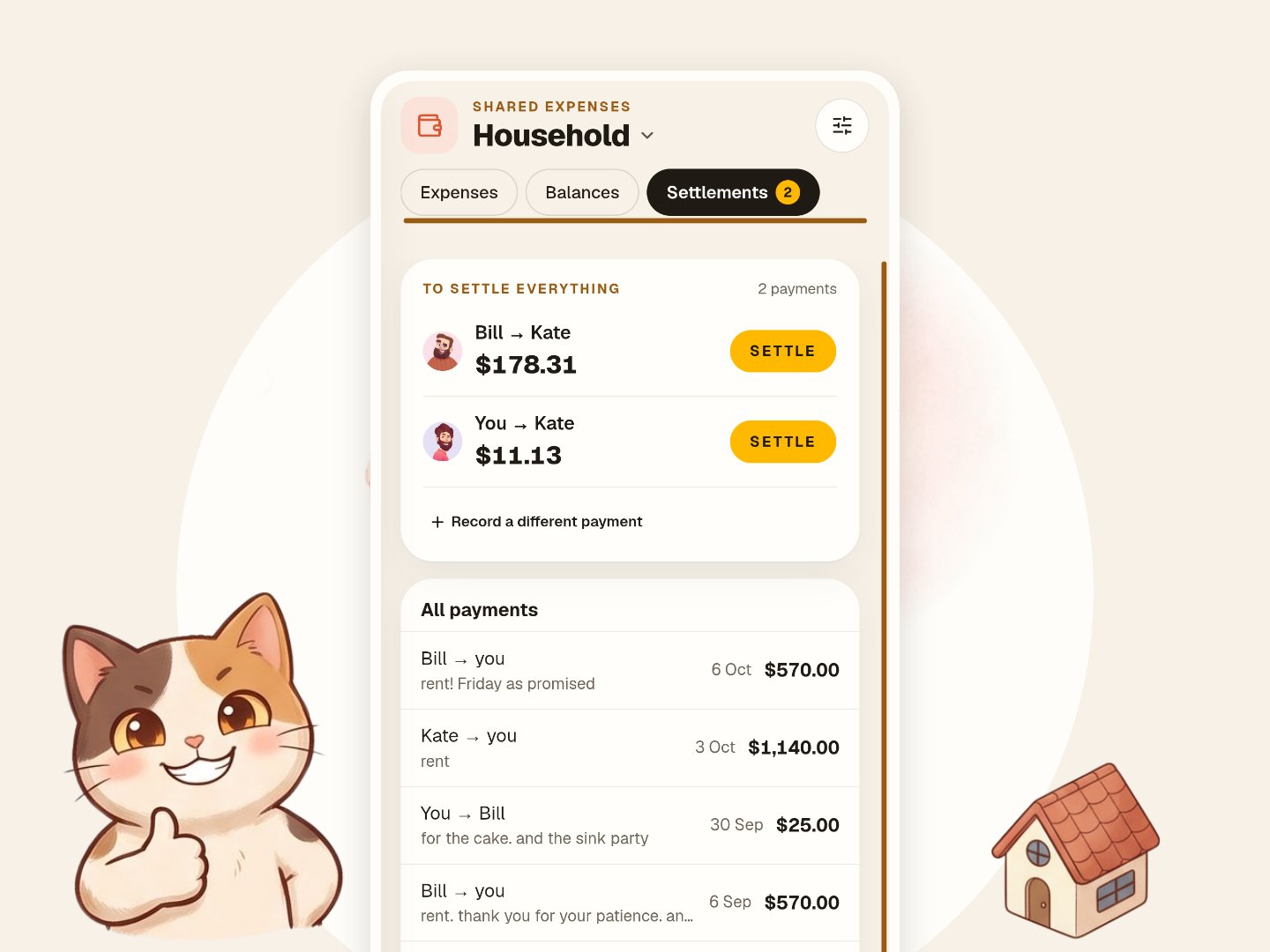
In our home, the shared bills live in Klusek's Shared Expenses. Whoever pays adds the expense, and it can be split equally or by percentage, so a 60/40 split by income is one tap rather than a calculator session at the kitchen table. Klusek keeps one running balance of who owes whom.
When it's time to settle, it shows the smallest set of payments that clears everything, and each payment goes into a history you can look back on, with a short note if you like ("rent, Friday as promised").
Klusek is free when you use it on your own. To share expenses with your partner, one of you needs a Klusek Pass, and the person you invite joins for free. There's more about money and chores for two on our page for couples.
Whatever you pick
If you've been avoiding this chat because it feels unromantic, try it with a cup of tea and the numbers on one screen. It usually takes ten minutes, and you both come out of it feeling looked after. That's worth a lot more than getting the percentage exactly right.