

You walk past the windowsill with your morning tea and there it is: a little green segment lying next to the pot. Then, the next day, another one. If you're asking "why is my Christmas cactus dropping leaves?", take a breath. It's almost always a reaction to a change (a move, a draught, too much or too little water), and it usually recovers once you work out which one.
Christmas cacti are a bit dramatic. They're also very forgiving. Here's how to read the signs.
Why is my Christmas cactus dropping leaves?
The "leaves" are really flat stem segments, and the plant drops them when something has upset it. These are the usual suspects, roughly in order of how often they're to blame:
- It's been moved. A new spot, a trip home from the garden centre in the cold, or a turn on the windowsill while it's in bud. Holiday cacti like things to stay the same, especially while buds are forming.
- A draught or a sudden temperature change. An opening front door, a cold window at night, or a radiator right underneath. Iowa State University Extension lists drafts and sudden changes among the main reasons buds fall (Iowa State, All About Holiday Cacti, checked 23 October 2026), and segments often go the same way. If yours lives near the heating, our post on plants near a radiator has some easy moves.
- Too much water. Soft, limp segments that drop easily usually mean the roots are sitting wet. Iowa State notes that overwatering leads to limp growth and root rot.
- Too little water. Wrinkly, thin segments that look deflated mean it's thirsty. Dryness while it's in bud also makes the buds fall.
- It's simply the season. A segment or two dropping as the weather changes can be perfectly normal. Watch the trend, not one leaf.
One fallen segment is a plant clearing its throat. A handful every day is the plant asking you to change something.
Is it too wet or too dry?
Push a finger into the compost. Wet, heavy and a bit sour-smelling: let it dry out and check the pot isn't standing in water. Bone dry and pulling away from the sides: give it a proper drink and let the excess drain. Our guide to the signs of overwatering helps if you can't tell.
Why is my Christmas cactus turning purple?
A purple or reddish tint on the segments is a stress signal, and it's usually one of these:
- Too much direct sun. The edges turn purple first. Holiday cacti prefer bright, indirect light, and Penn State Extension says full sun damages them (Penn State Extension, Holiday Cacti Care, checked 23 October 2026).
- Cold. A spell against a cold window glass in winter can tint it too.
- Hungry or crowded roots. The Pennsylvania Horticultural Society suggests regular feeding from spring to mid-autumn, and notes that Christmas cacti have a higher need for magnesium, so a teaspoon of Epsom salts per gallon of water once a month in spring and summer can help (not in the same week as the normal feed). A plant that's been in the same pot for years may also struggle to take up what it needs (PHS answer on purple Christmas cactus leaves, checked 23 October 2026).
The good news: once the cause is fixed, the colour usually goes back to green. Don't repot it in the middle of flowering, though. Spring is the time.
How often to water Christmas cactus when blooming
This is where many of us get it slightly wrong, because the rules change with the season.
- While it has buds and flowers: keep the compost evenly moist, never soggy. Iowa State says dryness at this stage can cause buds and flowers to drop. In a warm flat that often means checking every few days and watering when the top centimetre or so feels dry.
- After flowering: move it somewhere a little cooler and water less.
- The rest of the year: water thoroughly, let it drain, and wait until the compost has dried before watering again.
Never let the pot sit in a saucer of water. A bit of gravel in the saucer, or tipping it out ten minutes after watering, solves that.
Christmas cactus or Thanksgiving cactus?
Many plants sold as Christmas cacti are actually Thanksgiving cacti or hybrids. Look at the edges of the segments: a Thanksgiving cactus has two to four small pointed teeth, while a true Christmas cactus has rounded, scalloped edges. Care is almost the same, so this is more of a fun fact to share at dinner, but it explains why yours might flower in November.
A quick checklist if yours is unhappy
Copy this onto a sticky note for the windowsill:
Christmas cactus check
[ ] Has it been moved in the last few weeks? Leave it in one spot now.
[ ] Any draught, cold glass or radiator nearby? Move it a little.
[ ] Compost soggy? Let it dry out, empty the saucer.
[ ] Compost bone dry? Water well and let it drain.
[ ] Purple edges? Less direct sun.
[ ] In bud? Keep it evenly moist and don't turn the pot.
[ ] After flowering? Cooler spot, less water.
How Klusek helps us with this
In our flat, every plant has its own watering rhythm in Klusek's Plant Care, and the Christmas cactus is no exception. Each plant gets its own schedule, and the collection is grouped by room, so it's easy to see that the kitchen windowsill ones need water this week and the bathroom ones don't.
When the cactus starts budding, we simply change how often it's due, and change it back after flowering. Whoever waters it ticks it off, so nobody gives it a second drink by accident, which, as you now know, is exactly what it doesn't want.
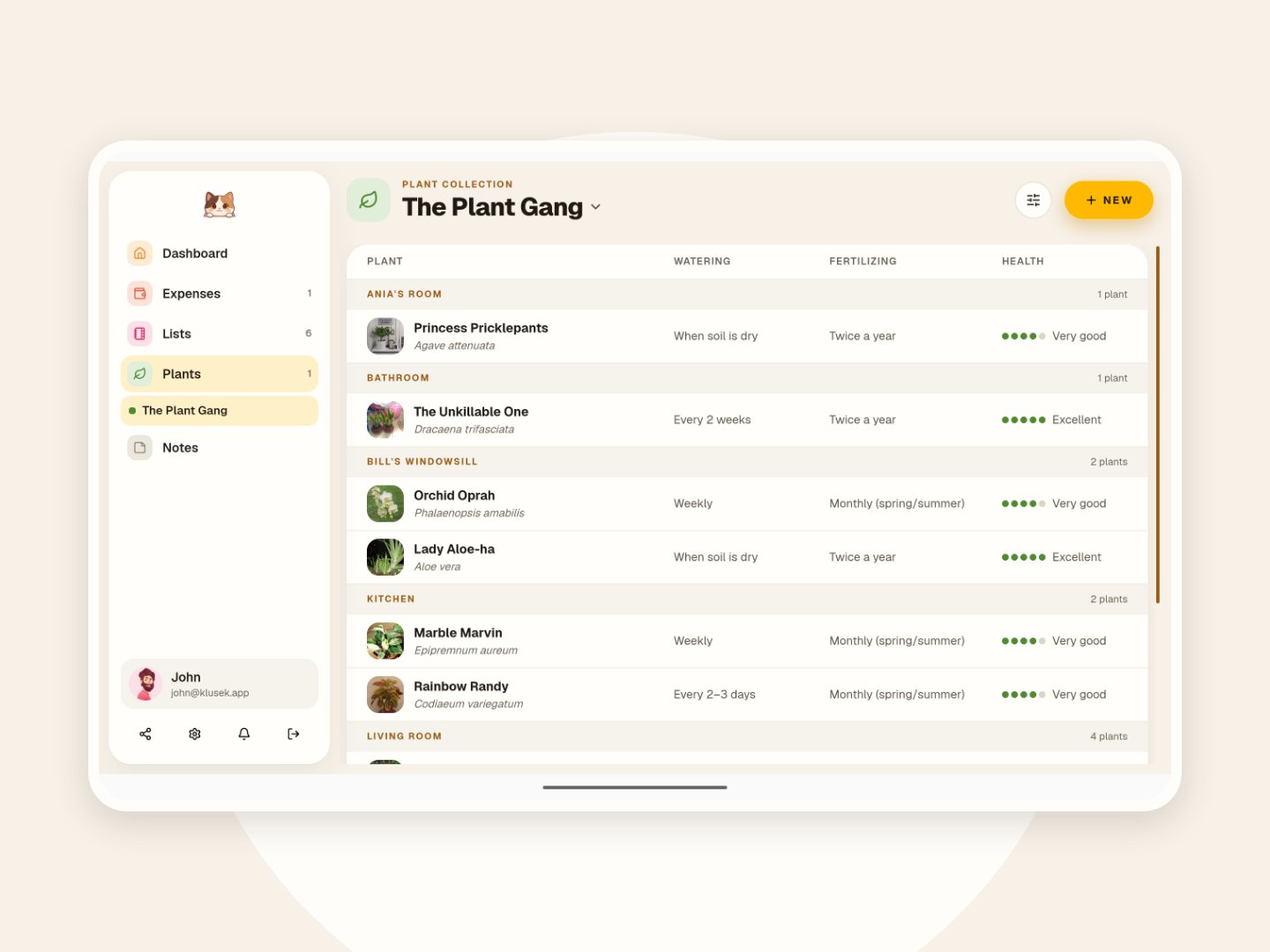
Plant Care is free when you use it on your own. To share your plants with a partner or housemate, one of you needs a Klusek Pass, and the people you invite join for free.
If there's a poinsettia on the table next to your cactus this year, our guide on how to keep a poinsettia alive is a good next read.
Be kind to yourself (and the cactus)
These plants live for decades, and they've survived far worse than one cold draught. Find a spot it likes, keep the watering steady, and give it a few weeks. Most of the time you'll see new segments at the tips by spring, and if you're lucky, flowers again next winter.