
Working from home in November means a laptop on the kitchen table, a blanket over the knees and the heating on while everyone else is at the office. Totally reasonable. Then the energy bill arrives, and somebody quietly wonders whether it should still be split three ways. If you want to split the electricity bill when someone works from home, the fairest simple method is this: keep most of the bill equal, and share a small "daytime" part by who is home during the day.
If you'd rather skip the maths, our utility split calculator does exactly this, with work-from-home days and time away built in. Below is how it works, and how to talk about it without anyone feeling told off.
Why an equal split stops feeling fair in winter
In summer, someone working from home adds very little: a laptop, a lamp and a lot of tea. In winter it's different. The heating runs all day only because someone is in, and it's usually the biggest energy cost a home has. The person at home knows it, the others notice it, and nobody wants to be the one to bring it up.
At the same time, a lot of the bill has nothing to do with daytime. The fridge runs all day either way, the evenings are shared, the showers are everyone's. That's why it's fair to adjust only part of the bill.
Splitting utility bills fairly: the simple method
- Sort your bills into two kinds. Flat bills cost the same whoever uses them, like internet and most standing charges. Usage bills go up and down, like electricity, gas or heating, and water.
- Split flat bills equally. Internet is a fixed price, so it's shared evenly.
- Pick a daytime share for usage bills. This is the part of the bill you agree to treat as daytime use. Something like 25% is a sensible middle; a bit higher in the depths of winter, lower in mild months.
- Split the daytime part by work-from-home days. Whoever is home more pays more of that slice.
- Split the rest equally. Everyone pays the same for the evenings, the fridge and the hot water.
The aim isn't a perfect meter for every person. It's a split everyone can say yes to without thinking about it again until spring.
Split the electricity bill when you work from home: an example
Three of you share a flat. In November, electricity and heating together come to £270 (or $270, the maths is the same). You agree on a 25% daytime share.
- Kate works from home four days a week.
- John works from home one day a week.
- Ania goes to the office every day.
The daytime part is 25% of £270, which is £67.50. Between them there are five work-from-home days a week, so Kate pays four fifths (£54) and John one fifth (£13.50). Ania pays none of this part.
The rest, £202.50, is split three ways: £67.50 each.
So for that bill:
- Kate: £54 + £67.50 = £121.50
- John: £13.50 + £67.50 = £81
- Ania: £67.50
That adds up to £270. Kate pays a bit more, and nobody pays for anyone else's evenings. The internet bill, being flat, is still split equally on top.
How to split utilities between roommates (and keep it friendly)
The method is the easy part. A few things help it land well:
- Let the person working from home suggest it. If that's you, offering a fair adjustment first is a lovely thing to do, and it usually makes everyone relax.
- Agree the daytime share once. Pick a number for the winter and keep it. Re-arguing it every month is no fun.
- Count time away too. If someone is away for a week, their share of the usage bills can drop for that month.
- Settle up on a rhythm. Once a month, when the bill comes in, is plenty.
If you're setting up the bills in a new place, our guide to splitting bills with roommates covers rent, groceries and the rest. And if it's the two of you as a couple rather than flatmates, you might also like should couples split bills 50/50, or by income.
How Klusek helps
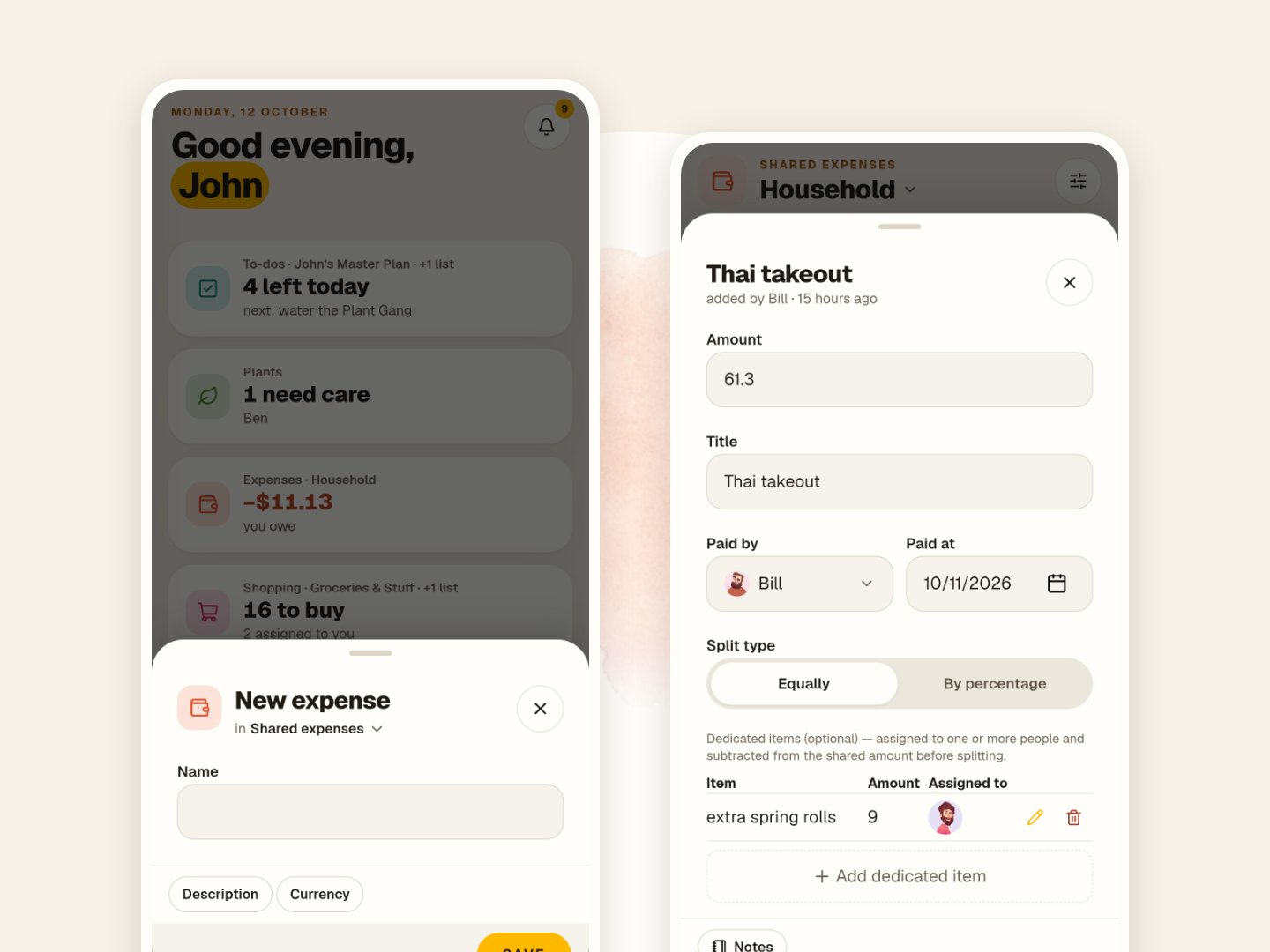
In our flat, the bills go into Klusek's Shared Expenses. Whoever pays the energy bill adds it as an expense, and it can be split equally, like the internet, or by percentage, like the heating bill in the example above (45%, 30% and 25%). The calculator's result goes straight in as percentages.
Klusek keeps one running balance of who owes whom, so the energy bill, the rent and last week's big shop all end up in the same place. If someone has a question, they can comment right on the bill, rather than starting a long chat thread.
Klusek is free when you use it on your own. To share expenses with your flatmates, one of you needs a Klusek Pass, and the people you invite join for free. There's more about bills and chores for shared flats on our page for roommates.
Warm flat, warm feelings
The heating should be about staying cosy, not about keeping score. Agree a fair split once, write it down, and get back to the more important winter questions, like whose turn it is to buy biscuits.